







Website Search
All the Library Can Be
The library is essential to a thriving community, ensuring equitable access to information, education, and technology for all. We raise funds to support Lexington Public Library programs, services, and special projects that go beyond what public dollars alone can support.
Learning doesn’t stop at the end of the school day. The Lexington Public Library is here to support your education at every level, from birth through college, with skill-building tools, live tutoring, standardized test prep, after-school programs, and more.
Lexington, Kentucky (March 9, 2022) – Lexington Public Library and Lexington Public Library Foundation are honored to announce that the Marksbury Family Foundation has committed the lead gift for the capital campaign to rebuild the library branch at the corner of Versailles Road and Village Drive. In recognition of their generosity, the new facility will be named the Marksbury Family Branch when it opens in 2024.
Friends of the Lexington Public Library provides financial, advocacy and volunteer support to the Library. Shop at the Friends Book Cellar in the Central Library for a great selection of used books, magazines, CDs, DVDs, audiobooks, and vinyl records, all at discounted prices.
Discover unique resources in our Digital Archives that tell the story of Fayette County. Visit cemeteries throughout Central Kentucky using our cemetery maps. Contact our resident experts in the Central Library's Kentucky Room with questions. The Lexington Public Library is a FamilySearch Affiliate Library.
With your free library card, gain access to a diverse collection of print books, ebooks, audiobooks, online classes and databases, and more. You can apply for a traditional, wallet-sized card and key chain tag or a digital library card to add to your smartphone’s digital wallet (iOS and Android compatible).
Together, we’ll enrich our Lexington Public Library for the next 230 years.
Tracing its history back to 1795, the Lexington Public Library is a gateway to knowledge, a bridge to opportunity, and a hub for community connection. The name of the society honors that legacy — when a small group of citizens came together to create something lasting for their community - a library positioned to evolve to meet the ever changing needs of our community.
Members of the 1795 Society are philanthropic leaders and dedicated library champions. Supporters make a three-year pledge of at least $1,000 per year - whether you are an individual donor interested in making an annual or monthly gift, you are making your estate plans, or you are a corporate partner looking to connect your organization to community impact, we invite you to join this legacy of connection, learning, and leadership in support of the public library!
Join the 1795 Society, a community who enable the Library’s critical work and build a legacy of learning, access and opportunity for generations to come.
The governance of Lexington Public Library is under the direction of 7 Trustees and up to 10 Advisors who guide the long-term strategies for the Lexington Public Library, including the long range plan, annual budget cycle, advocating for the library and for library customers, and policy recommendations.
Monday-Thursday: 9:30am-7:00pm
Friday: 9:30am-6:00pm
Saturday: 9:30am-5:00pm
Sunday: 1:00pm-5:00pm
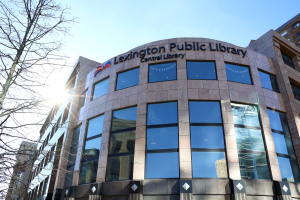
140 East Main Street
Lexington, KY 40507
The Lexington Public Library welcomes your time and talents! There are a number of volunteer opportunities available, and we will accommodate your preferences for location and hours as much as possible based on what we have available. From After School programs, to ESOL programs, to Makerspace open studio help, and beyond—we have a variety of opportunities for you to connect with your community through volunteering.
The Lexington Public Library’s Digital Archives provide open access to researchers and students to learn more about the rich history of Lexington and Fayette County. It contains a fraction of the Library’s physical holdings, which are housed and available for reference in the Kentucky Room at the Central Library. New material is being digitized and added constantly, so there's always something new to find.
Read the latest news from Lexington Public Library.
741.5 is written and designed by Lexington Public Library staff member Bill Widener. The inaugural issue came out in January 2017. Sub-titled The Comics & Graphic Novel Bulletin of the Lexington Public Library, its intent is to promote new arrivals to the Library's comics collections. 741.5 takes its name from the numeral designation within the Dewey Decimal System that covers comics and cartooning.
Your tax-deductible gift to the Lexington Public Library Foundation funds innovation in our public library system. We raise funds to support Lexington Public Library programs, services, and special projects that go beyond what public dollars alone can support, today and for generations to come. The Library Foundation will send you an email confirmation of your gift and a year-end summary and tax acknowledgement receipt.
Discover everything that's happening this summer at the library!
Lexington, Kentucky (August 18, 2022) – The Lexington Public Library broke ground on a new, significantly larger facility in the former Village Branch location on Versailles Road to better provide for the needs of the neighborhoods it serves. The new branch will reflect the community’s vision for a state-of-the-art community hub, one that offers robust resources and a myriad of program and service offerings. The groundbreaking ceremony was held on Tuesday at a media event featuring Library and City officials.
The Materials Selection Policy was initially adopted February 25, 1987 by the Lexington Public Library Board of Trustees and was revised March 24, 1993. The Materials Selection Policy was updated and renamed the Collection Development Policy which was approved by the Board on January 14, 2009. The Board of Trustees assumes full responsibility for all legal actions which may result from the implementation of any policies stated herein.
The Central Library's Parking Garage is available to our customers or anyone needing a parking space. There are 428 parking spots in the garage, 10 of which are handicapped or van accessible. The height clearance for garage entry is 13'1". The height clearance for parking access is 6'4".
Two hours of free parking is provided with a ticket validated inside the Central Library.
The Lexington Public Library receives most of its operating funds from an Ad Valorem property tax. By State law, the Library receives five cents for every $100 of assessed property value in Lexington and Fayette County.
Everyone deserves a place to discover something new. The Lexington Public Library stands for free and open access to information. We’re a safe, welcoming space for neighbors to come together — opening the door so all Lexingtonians can find what they’re looking for.
Lexington, Kentucky (April 12, 2023) – The Lexington Public Library will be Fine Free for all materials, effective immediately, following a vote at today’s regularly scheduled monthly board meeting. Lexington Public Library customers will no longer incur fines for late, damaged, or lost library materials. Additionally, the Library has forgiven all current, outstanding fines
Lexington, Kentucky (February 1, 2024) – This February, Lexington Public Library is proud to join the nation in celebrating Black History Month, a time dedicated to honoring the achievements, contributions, and rich cultural heritage of African Americans.
Lexington, Kentucky (January 17, 2024) – Lexington Public Library is proud to announce the Grand Opening of the Marksbury Family Branch of the Lexington Public Library.
Festivities include a Media Day event on Friday, March 8 from 8:30-10am and a Grand Opening Celebration on Saturday, March 9 (more details coming soon). The current Village Branch will remain open through 6pm on Friday, February 23.
How can we help you? We've gathered a variety of resources for readers, students and educators, job seekers. entrepreneurs and nonprofits, and English language learners. Request items from other libraries through interlibrary loan.
The 1795 Society is a community of donors whose leadership gifts strengthen Lexington Public Library’s ability to serve, inspire, and connect our neighbors. Named for the year the library was first imagined in Lexington, the society honors those who invest in a legacy of learning, access, and opportunity for generations to come.